



search
date/time

Thu, 10:00AM
clear sky
4.1°C
NW 5mph
clear sky
4.1°C
NW 5mph
 | Sunrise | 5:35AM |
| Sunset | 6:43PM |  |

Andrew Liddle
Guest Writer
P.ublished 14th February 2026
frontpage
Closer To The Edge Than In 1962?
We came within a hair’s breadth of nuclear war without realising it. It was luck that prevented nuclear war.
The world could end, we were told, suddenly, irreversibly, and without warning. I cannot deny this left a lasting impression on a 13-year-old schoolboy. The gallow’s humour at the time was, “Don’t worry, lad, you won’t feel a thing!”
Younger generations today, by contrast, experience nuclear war almost entirely through history books, simulations, video games and films. It is something that almost happened long ago and was sensibly avoided. The fact that the world survived in 1962 is often taken as proof that it always will - that systems work, leaders pull back, and disaster is averted in the nick of time. Let’s laugh about it and get back to the serious business of Tik-Tok.
But the truth is these two perspectives could not be more different. And the older one is closer to the truth. In October 1962, the world came closer to nuclear annihilation than at any other point in history - and everyone involved understood it. John F. Kennedy faced down generals urging airstrikes. Nikita Khrushchev confronted a Politburo that did not want to retreat. Both men understood, with terrifying clarity, that a single mistake could end civilisation. Fear was not a weakness; it was a strength, the stabilising force.
Even then, luck may have played a starring role. The Soviet submarine B-59, nuclear-armed, nearly launched a torpedo at the U.S. Navy. Valentin Savitsky hesitated, and only the intervention of Vasily Arkhipov prevented catastrophe. In Cuba, questions lingered over whether Soviet troops under Issa Pliyev had authority to use tactical nuclear weapons. Draft instructions existed but were unsigned. Small human decisions - by sometimes one person - determined the fate of millions.
Khrushchev was horrified when Fidel Castro suggested nuclear war might be an option. “Only a person who has no idea what nuclear war means… can talk like that,” he said. Yet, he was comfortable with nuclear posturing, an act he would later regret.
The danger was real, but constrained by human judgement, fear, and uncertainty. McNamara’s reflection makes the lesson clear: survival often depended on the luck inherent in human decisions, not the strength of the systems.
Fast forward to today. Technical safeguards are admittedly stronger: satellites, hardened silos, secure communications, AI-driven early warning, and stealthy second-strike submarines make accidental or unauthorised launches far less likely. On paper, nuclear war is harder to start. On paper, Hitler was certain he had a master plan.
Yet the world is more dangerous in other ways. Modern crises are multipolar, compressed in time, and intertwined. Nuclear weapons are spread across at least nine nations, each with distinct doctrines, domestic pressures, and regional flashpoints. Conflicts like Ukraine and the South China Sea bring nuclear-armed states into close, real-time confrontation. Artificial intelligence, cyberwarfare, and compressed decision-making timelines mean that miscalculations can escalate faster than any human can fully comprehend.
Culture amplifies the danger. For generations raised on video games, simulations, AI-driven media, and nonstop news, the line between reality and rehearsal is often blurred. Nuclear war is treated like a strategic puzzle, a cinematic climax, or a video-game level with “undo” buttons. But this is not a video game. This is not a fantasy. Every alert, every escalation, is real, irreversible, and unforgiving. Hollywood reinforces the illusion: in Dr. Strangelove, a doomsday machine triggers apocalypse without human intervention. Reality does not offer “undo” buttons.
The psychological effect is corrosive. Disaster becomes familiar, manageable, even dull. We rehearse the end of the world so often that we confuse rehearsal with immunity.
To illustrate, consider a plausible path to escalation today: let’s say a regional crisis flares near Taiwan. Naval and air forces collide or misinterpret manoeuvres. Cyberattacks degrade communications. Early-warning systems detect launches that may not exist. Leaders have minutes to decide. Advisors urge decisive action to maintain credibility. Momentum builds. Escalation spirals. Mission creep comes into play. No one seeks nuclear war - but each step feels justified.
The Cuban Missile Crisis was bipolar, relatively controlled, and shaped by leaders who had first-hand experience of war’s horrors. Today, nuclear brinkmanship is multipolar, automated, normalised and led by individuals who have never faced existential devastation directly. Historical lessons are vital, but no longer sufficient.
Even when technical safeguards function perfectly, human perception remains the wildcard. Overconfidence, cultural desensitisation, and abstract simulations give a dangerous sense of control. Reality offers no rehearsal.
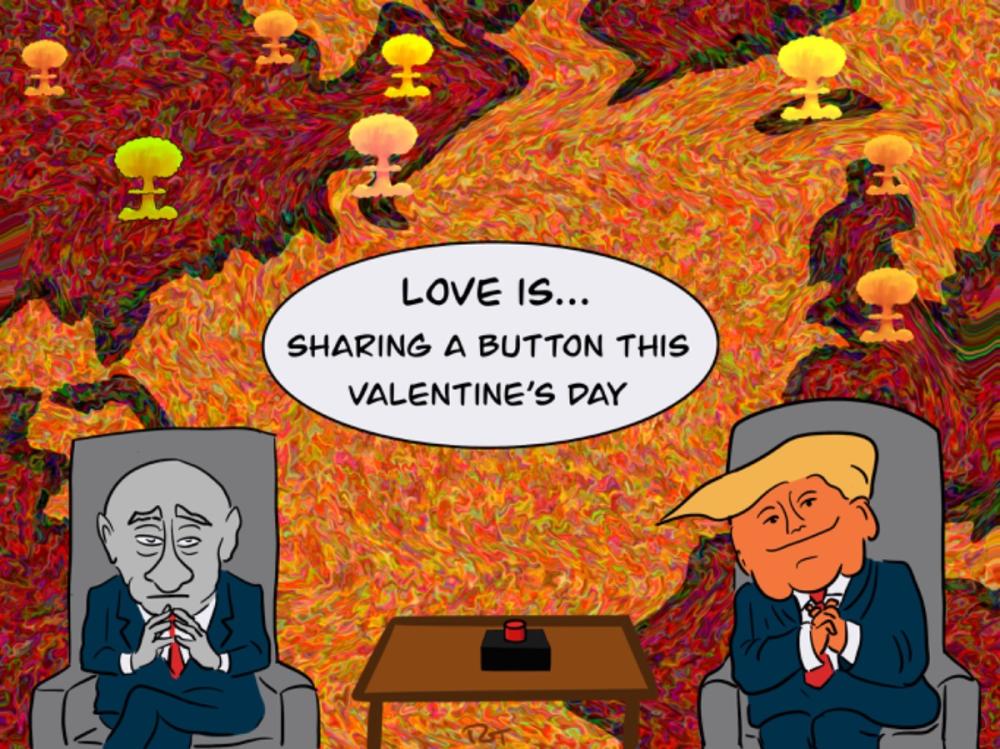
History also reminds us that leadership matters. Khrushchev and Kennedy were both shaped by personal experiences of war’s horrors, which restrained risk-taking. Putin, who has never endured comparable devastation, may evaluate nuclear brinkmanship very differently. His willingness to use threats, signals, and coercion may be amplified by a lack of personal understanding of war’s consequences. Trump? Well who can say what makes him tick or what idea he may espouse one day and abandon the next. Would he back down in a showdown? And, pray tell, what happens when AI is in the room, making predictions, offering advice, as it will be?
Technical improvements alone cannot guarantee safety. Satellites, second-strike submarines, and secure communication channels reduce accidental launches, but they cannot eliminate the human element, the misinterpretation, or the momentum that we know escalates a crisis. Luck cannot be coded.
Meanwhile, media and culture encourage complacency. We consume disaster as a form of entertainment: films end with last-second salvation, video games allow rewinds, AI simulations let young generations rehearse catastrophe without consequence. Society becomes desensitised, accustomed to imagining annihilation without fear. Yet nuclear war is absolute, irreversible and totally unforgiving. There is no pause, no save point, no rewind, no cinematic resolution. The cavalry does not come to the rescue. Destry does not ride again when destiny has called.
The lesson is simple and terrifying: nuclear deterrence is no longer just about missiles or silos. It is about psychology, culture, judgement, and chance. Where once fear restrained, today abstraction and confidence can embolden. Where once one human decision saved the world, today misjudgement can cascade across systems, AI, and geopolitics.
We may be closer to the edge than most realise. The margin of survival may still depend on a single human choice - but the difference is that human awareness of danger is far less acute, while the systems around them are far more complex, fast, and unforgiving.
The Cuban Missile Crisis ended not with triumph, but with fear, concession, and relief. Kennedy removed U.S. missiles from Turkey. Khrushchev retreated. Humanity survived because fear restrained, experience guided, and luck intervened.
The world today is arguably more dangerous than it was in 1962 - not because of a single showdown, but because we inhabit permanent, normalised brinkmanship. We are conditioned to see disaster as rehearsable, cinematic, or virtual. Reality does not pause for rehearsal.
And this time, luck may not be on our side. I can hear my father’s words, 60-odd years on. “Don’t worry, lad, you won’t feel a thing!”