



search
date/time

Tue, 1:00AM
light rain
19.1°C
SW 14mph
light rain
19.1°C
SW 14mph
 | Sunrise | 5:36AM |
| Sunset | 6:27PM |  |

Richard Trinder
Managing Editor
@richardtrinder
P.ublished 14th September 2026
scitech
BepiColombo Begins Its Arrival At Mercury
Mercury is very, very hot on one side. And Mercury is very, very cold on the other. It is constantly blasted by an intense stream of particles from its nearest neighbour (the Sun) and has almost no atmosphere to protect it from meteorite bombardment. And that fiery cauldron is where ESA is planning to place two flying science stations, each packed with supremely sensitive instruments. It's a challenge, and an ambitious one.
The name BepiColombo was given to the mission in honour of Professor Giuseppe (Bepi) Colombo (1920–1984) who is best known for his work on the planet Mercury and, more specifically, for his work on NASA's Mariner 10, where he demonstrated how to put a spacecraft into orbit using a series of flybys to slow it down.
This mission is significant as it is the first European-led effort to study Mercury in detail.
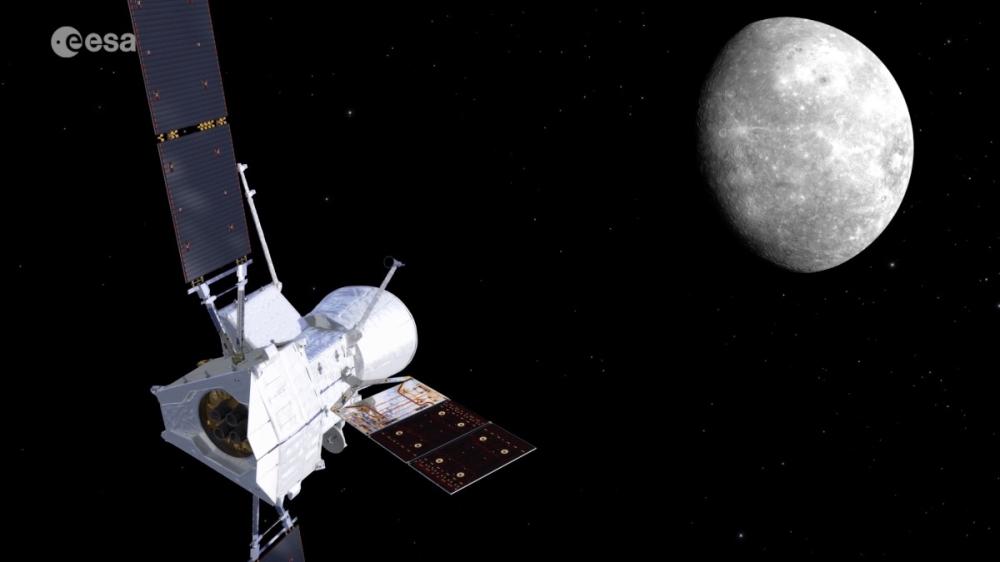
The four composite BepiColombo spacecraft is approaching Mercury. Solar electric propulsion thrusters are turned off, priming the spacecraft for the beginning of complex planetary arrival sequence. Photo © ESA
Three Part Mission
The BepiColombo mission consists of three main components:
Mission Timeline
| Event | Date |
|---|---|
| Launch | 20 October 2018 |
| Mercury Flybys | 2021 - 2025 |
| Arrival at Mercury | November 2026 |
| Start of Science Operations | April 2027 |
Video © ESA
Scientific Objectives
BepiColombo has a wide range of objectives, not least of which is the rather grand aim of 'enhancing our understanding of the formation of the solar system', but more specifically it should address a few anomalies about the planet:
Does Mercury have water ice in polar craters? The presence of water on a planet so close to the Sun seems unlikely but evidence collected by NASA's Messenger spacecraft seems to indicate that billions of tons of frozen water lie just below the surface. A team from UCLA (University of California, Los Angeles) has suggested that black deposits near the poles are a thin crust of organic material brought to the planet over the past several million years by water-rich asteroid and comet impacts. If true, the large scale presence of such material would profoundly change the likelihood of finding life elsewhere in the universe.
How does the magnetic field of Mercury interact with the solar wind? Previous missions and an earlier flyby of BepiColumbo have measured a small, global magnetic field around Mercury, about 1.1% as strong as Earth's. Its magnetic field is generated by a dynamo mechanism involving a molten iron core, like the Earth, but because Mercury orbits so close to the Sun, its interaction of the solar wind with the magnetosphere and with the surface of the planet is vastly more intense than on Earth. Exploring the dynamics of Mercury's magnetic bubble and the properties of the particles contained within it is one of the main aims of BepiColombo’s mission.
And as an almost throwaway science objective, the BepiColumbo mission will make very precise measurements of the spacecraft's orbit and position and provide a valuable analysis of the accuracy of Einstein's Theory of Relativity.
European Space Agency and JAXA
BepiColumbo was launched on 20 October 2018 on an Ariane 5 rocket from Europe's Spaceport and is the result of close cooperation with JAXA (Japan Aerospace Exploration Agency). After numerous flybys of Mercury on 1 Oct 2021, 23 June 2022, 19 June 2023, 4 Sept 2024, 1 Dec 2024 and 8 Jan 2025 - in an attempt to slow down enough for orbital insertion around the planet (using the ideas of Professor Colombo, of course) - the spacecraft should be arriving in December (2026) and ready for routine science operations in April (2027). Apart from the extraordinary science data it is likely to collect, BepiColombo is a clear expression of an emboldened European Space Agency and its Japanese partners.
Also by Richard Trinder...
Northern Ballet's Gentleman JackWhat Will Roman Do For Us?The Sound Of An Appreciative AudienceAn Interplay With Phoenix DanceSilver & Gold: Long John Silver Restores His Reputation?The shortened address for this article is: newspub.uk/320x3
Search Results